Catholic Beliefs and Practices — The Seven Sacraments, Mass & More
What does it mean to be Catholic? Beyond the stained glass and incense, the Catholic faith rests on a rich theological foundation spanning two thousand years. This guide explores the central beliefs and practices that unite Catholics from Rome to Harare, from Manila to New York.
Faith: The Starting Point
Catholic theology teaches that faith is both a gift from God and a human response to divine revelation. It is not blind belief but a reasoned trust in God who has revealed Himself through creation, through Scripture, and ultimately through Jesus Christ. The Church distinguishes between the preambles of faith — truths knowable by reason alone, such as God's existence — and the mysteries of faith that surpass human understanding, like the Trinity.
Revelation: Scripture and Tradition
Catholics believe God reveals Himself through two channels: Sacred Scripture (the Bible) and Sacred Tradition (the living transmission of the faith from the Apostles through the Church's teaching and worship). Neither stands alone; together they form the single "deposit of faith" entrusted to the Church.
The Catholic Bible contains 73 books — 46 in the Old Testament and 27 in the New Testament. You can explore the Scriptures in local languages through our Shona Bible, Ndebele Bible, and English Bible sections.
The Nicene Creed: Summary of Belief
Every Sunday at Mass, Catholics profess the Nicene Creed, a statement of faith formulated at the Councils of Nicaea (325 AD) and Constantinople (381 AD). It affirms belief in the Trinity — one God in three Persons: Father, Son, and Holy Spirit — the Incarnation, the death and Resurrection of Christ, and the hope of eternal life.
The Seven Sacraments
Sacraments are visible signs of invisible grace, instituted by Christ. The Church recognises seven:
1. Baptism
The gateway to the Christian life. Through water and the Holy Spirit, original sin is washed away, and the person is incorporated into Christ and the Church. Baptism is necessary for salvation and is administered to both infants and adults.
2. Confirmation
The completion of baptismal grace. Through the anointing with sacred chrism and the laying on of hands by a bishop, the Holy Spirit strengthens the confirmed to be witnesses of Christ in the world.
3. The Eucharist
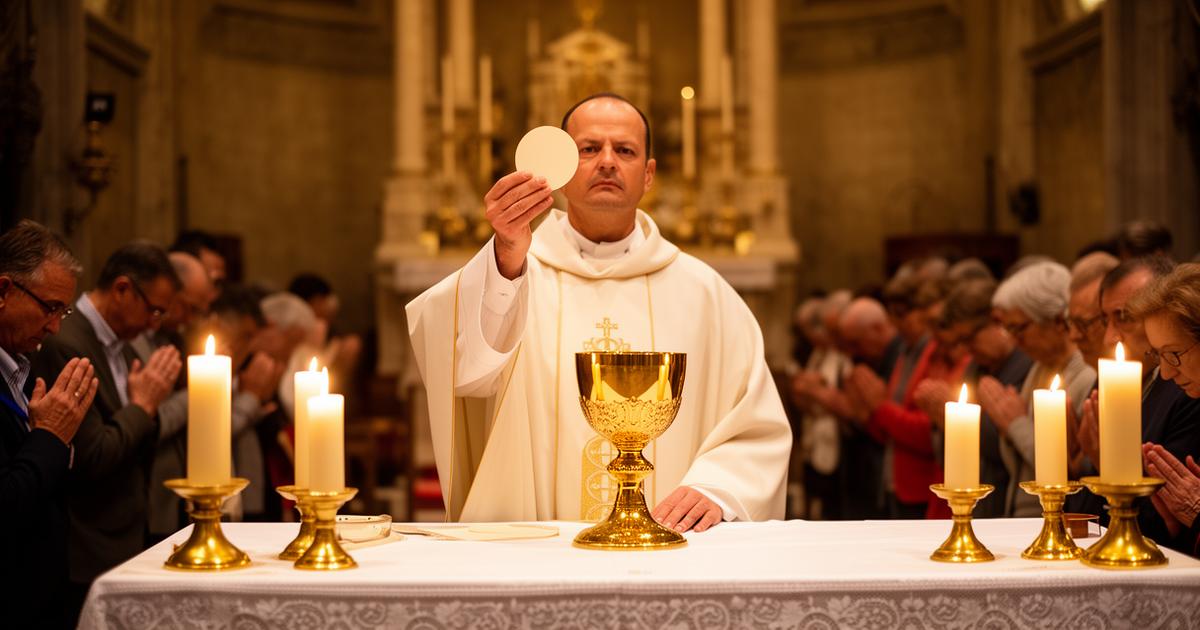
The "source and summit" of Catholic life. Catholics believe that during Mass, bread and wine become the actual Body and Blood of Jesus Christ — a mystery called transubstantiation. Receiving Holy Communion is the most intimate encounter with Christ available to the faithful.
4. Reconciliation (Confession)
Christ gave the Apostles the power to forgive sins (John 20:23). In the sacrament of Reconciliation, the penitent confesses sins to a priest, receives absolution, and is restored to full communion with God and the Church.
5. Anointing of the Sick
When a Catholic faces serious illness or the frailty of old age, a priest anoints them with holy oil and prays for healing of body and soul. This sacrament brings comfort, strength, and the forgiveness of sins.
6. Holy Matrimony
Marriage between a baptised man and woman is a sacrament — a covenant reflecting Christ's love for the Church. It is lifelong and open to the gift of children.
7. Holy Orders
Through ordination, men are consecrated as deacons, priests, or bishops to serve the Church through preaching, sacramental ministry, and pastoral leadership.
The Mass: Heart of Catholic Worship
The Mass is the central act of Catholic worship. It consists of two main parts: the Liturgy of the Word (readings from Scripture and the homily) and the Liturgy of the Eucharist (the consecration and reception of Holy Communion). The Mass is celebrated daily around the world, and attending Sunday Mass is considered obligatory for all Catholics.
Music is integral to the liturgy. In Zimbabwe, the Mass comes alive through Shona Catholic hymns and Ndebele hymns that blend African musical traditions with the universal liturgy.
Devotion to Mary and the Saints
Catholics honour Mary as the Mother of God and the greatest of all saints. Devotions like the Holy Rosary and the Angelus are beloved prayer practices. Catholics also ask saints to intercede — to pray to God on their behalf — much as one might ask a friend for prayers.
Catholic Moral Teaching
Catholic ethics are grounded in the natural law — the moral order written into creation — illuminated by Scripture and the Church's teaching tradition. Key principles include the dignity of every human person, the common good, solidarity with the poor, and the sanctity of life from conception to natural death.